
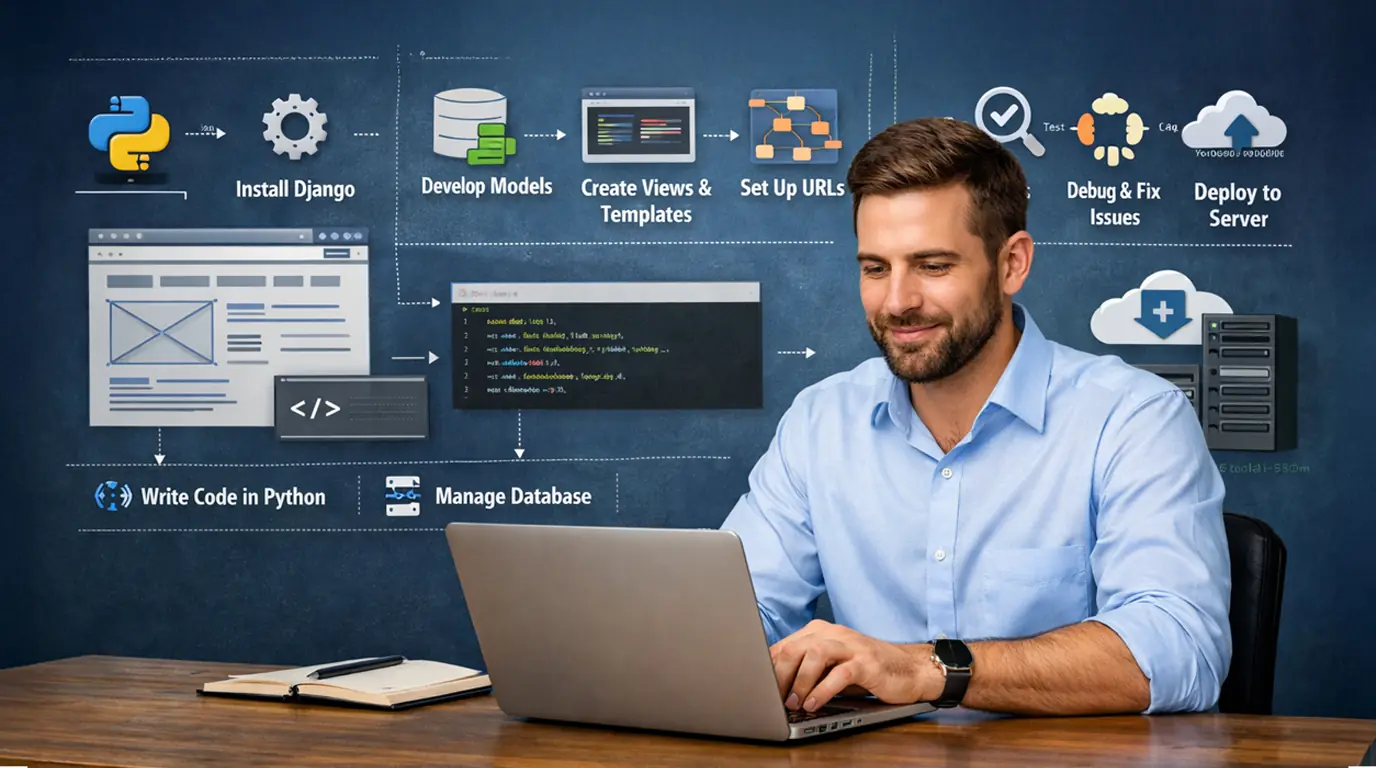
How to Build Your First Web Application Using Django

Overview

Django is one of the most powerful and beginner-friendly web frameworks built using Python. It allows developers to create secure, scalable, and high-performance web applications efficiently. If you are planning to enroll in a Python Django course, building your first application is the best way to understand how development works in real-world scenarios. Many learners begin with a Python Django Web Development course to understand core concepts and then move forward with a Python Django Full Stack Web Development course to gain complete development skills. This guide will help you get started step by step.

What is Django?

Django is a high-level Python web framework that enables rapid development and clean design. It follows the Model-View-Template (MVT) architecture and provides built-in features like authentication, database management, and an admin panel. Most beginners start learning these fundamentals through a Python Django course, while a Python Django Web Development course helps you apply these concepts in practical scenarios. For advanced skills, a Python Django Full Stack Web Development course prepares you to build complete applications.

Prerequisites

Before you start building your Django application, you should have:

  • Basic knowledge of Python
  • Python installed on your system
  • pip (Python package manager)
  • Basic understanding of HTML

These fundamentals are typically covered in a Python Django course, and further strengthened through a Python Django Web Development course, while a Python Django Full Stack Web Development course ensures hands-on experience.

Step 1: Install Django

Install Django using pip:- pip install django

Check the version:- django-admin –version

Step 2: Create a Django Project

Create a new project:

django-admin startproject myproject

cd myproject

python manage.py runserver

Open your browser:
👉 http://127.0.0.1:8000/

Step 3: Create a Django App

python manage.py startapp myapp

Add the app to INSTALLED_APPS in settings.py.

Step 4: Create a Model (Database)

from django.db import models

class Post(models.Model):

    title = models.CharField(max_length=200)

    content = models.TextField()

    def __str__(self):

        return self.title

Run:

python manage.py makemigrations

python manage.py migrate

Step 5: Create Views

from django.shortcuts import render

from .models import Post

def home(request):

    posts = Post.objects.all()

    return render(request, ‘home.html’, {‘posts’: posts})

Step 6: Configure URLs

from django.urls import path

from . import views

urlpatterns = [

    path(”, views.home, name=’home’),

]

Step 7: Create Templates

<!DOCTYPE html>

<html>

<head>

    <title>Django App</title>

</head>

<body>

    <h1>My First Django App</h1>

    {% for post in posts %}

        <h2>{{ post.title }}</h2>

        <p>{{ post.content }}</p>

    {% endfor %}

</body>

</html>

Step 8: Use Django Admin Panel

python manage.py createsuperuser

Register model:

from django.contrib import admin

from .models import Post

admin.site.register(Post)

Step 9: Run Your Application

python manage.py runserver

Your app is now live locally 

Step 10: Deploy Your Application

You can deploy your Django app using:

  • VPS (AWS, DigitalOcean)
  • Platforms like PythonAnywhere or Render

Deployment and real-world project training are usually included in a Python Django Full Stack Web Development course, while a Python Django Web Development course helps you understand project structure, and a Python Django course builds your core knowledge.

Why Learn Django for Full Stack Development?

Django is widely used for:

  • Web applications
  • SaaS platforms
  • E-commerce systems
  • API development

A Python Django course helps you get started, a Python Django Web Development course builds your development skills, and a Python Django Full Stack Web Development course prepares you to handle complete projects from front-end to deployment.

Tips for Beginners

  • Start with small projects
  • Practice daily
  • Learn Django ORM and templates
  • Build portfolio projects
  • Explore REST APIs

These practical skills are reinforced in a Python Django course, enhanced in a Python Django Web Development course, and mastered in a Python Django Full Stack Web Development course.

Conclusion

Building your first web application using Django is an important step in your development journey. It gives you a clear understanding of how real-world applications are created and managed. To build a successful career, starting with a Python Django course, progressing through a Python Django Web Development course, and advancing into a Python Django Full Stack Web Development course can help you become a job-ready developer with strong practical skills.

  • Digital Marketing
  • Graphic Design
  • MERN Stack
  • Python Django
  • Technology Trends
  • Tutorials
  • UI/UX Designing
  • UX/UI Design
  • Web Designing
  • Web Development
  • WordPress
    •   Back
    • Python Django Tutorial
    • WordPress Tutorial
    • Graphic Design Tutorial
Previous Post
Next Post

Most Recent Posts

  • All
  • Digital Marketing
  • Graphic Design
  • MERN Stack
  • Python Django
  • Technology Trends
  • Tutorials
  • UI/UX Designing
  • UX/UI Design
  • Web Designing
  • Web Development
  • WordPress
    •   Back
    • Python Django Tutorial
    • WordPress Tutorial
    • Graphic Design Tutorial

Category

  • All
  • Digital Marketing
  • Graphic Design
  • MERN Stack
  • Python Django
  • Technology Trends
  • Tutorials
  • UI/UX Designing
  • UX/UI Design
  • Web Designing
  • Web Development
  • WordPress
    •   Back
    • Python Django Tutorial
    • WordPress Tutorial
    • Graphic Design Tutorial
What is MERN Stack? A Complete Beginner’s Guide

April 11, 2026

Discover how AI is transforming digital marketing by improving automation, personalization, and campaign performance. This guide explains how modern marketers use AI tools to generate leads, optimize content, and boost ROI. Learning these in-demand skills through a Digital Marketing course can help you stay ahead in today’s competitive online landscape.

How AI is Transforming Digital Marketing

March 20, 2026

Discover how AI is transforming digital marketing by improving automation, personalization, and campaign performance. This guide explains how modern marketers use AI tools to generate leads, optimize content, and boost ROI. Learning these in-demand skills through a Digital Marketing course can help you stay ahead in today’s competitive online landscape.

How to Improve Website Speed for SEO

March 20, 2026

Website speed is a critical factor for SEO and user experience in 2026. This guide explains how to improve your website’s loading time using proven techniques and tools. Whether you're learning through a Digital Marketing course or managing your own website, understanding speed optimization can help boost rankings, traffic, and conversions. Mastering these skills through a Digital Marketing course can give you a strong advantage in today’s competitive...

© Copyright 2026 Institute Of Web Technology. All rights reserved